
Is there any point in having a name if no one is around to call you by it? What is identity in an isolated world where there's no need to identify yourself? What's the point of living — beyond responsibilities, desires, human connection, and the necessities of survival — what truly drives a human to live? I Who Have Never Known Men encourages these kinds of reflections.
Author Jacqueline Harpman was a Belgian woman born in 1929 to a Jewish father. She and her family fled to Casablanca, Morocco during WWII when the Nazis invaded and returned after the war. Harpman's history of displacement, isolation, and survival highlights how our narrator resists her own isolation, with the most prominent theme being the pursuit of knowledge.
A Name For No One
As our narrator has no memories before waking up as a child in a cage with 39 other women, she is nameless. The women in the cage don't give her a name either; they refer to her as "child," a nickname, a term of endearment — call it what you want — but "child" is not the name her mother or father gave her. Her name is lost in the ether of the past, lost connections, and forgotten memories.
This doesn't seem to bother the woman whose life we follow, but she doesn't know any different; we, as readers, do. What does this mean? Throughout the story, the woman's nonchalance about the matters the 39 other women stress reminds us that she represents how a woman might think in a world with no societal norms or expectations.
Unknown World
The world the 40 women woke up in was not Earth; they remember chaos, alarms going off, and then waking up in their bunker, without their families, their children, husbands, belongings; they woke up in a strange, cold place with women from all over the world in the same position as them; save for our narrator, of course, who was the only child and the only one with no memories of anything but the world she woke up in inside that cage.
When the alarms went off several years after they'd been in the bunker, the guards on duty abandoned their posts, and within 7 minutes, they were completely alone. It took only 7 minutes for these women to realize they were free as they climbed the stairs to the surface.
Imagine breathing fresh air for the first time in so many years, and the idea clicking into place: you are not on the planet you've known your whole life; you're alien and alone. Their new planet barely has any vegetation, trees, or fresh water; there are no animals, no human life, yet — as they later come to realize as they come across hundreds, if not thousands, of other bunkers throughout their years traveling on foot — they have seemingly endless access to shelter, food, and filtered water.
Survival
In 40+ years, a bunker was never found without a cage of 40 dead women or 40 dead men. As sad as that is, I think our narrator learned a lot from the dead people in those cages. Sometimes they walked down to a massacre of 40 people fighting tooth and nail to survive. But other times she walked down to a scene of 40 people peacefully dead in their beds.
The cage-of-corpses scene that stood out to our narrator most was when she walked down to inspect yet another cage, except this one had something different. She saw a chaos of corpses, nothing new there, save for one. A man had positioned himself and the mattresses around him so that he was literally facing death. He sat as straight as his body would allow and had his head held high; that was how he died.
The never-ending cycle of bunkers filled with corpses became depressing to the women as time went on:
"The women had discovered that survival is no more than putting off the moment of death."
And so it did; the years passed, and whether it was through natural causes, suicide, or a merciful knife to the heart, death claimed each one of the women until our narrator was left completely alone.
The Pursuit of Knowledge
This is where I begin to ask myself questions; I put myself in her shoes. In a world where nothing determines what matters, a world with no laws, societal norms, bank accounts, birth certificates, careers, families; a world that is void of anything but yourself, food, water, and shelter, what's the intrinsic drive to live? Survival isn't the answer here, and neither is the pursuit of human life — that door is already closed. So what is it?
I don't think there is a single answer; it might be different for anyone who picks up this book, but for me, it's the pursuit of knowledge.
We follow our narrator's curiosity throughout this entire story. She has a constant desire to know, to think, to explore not just her mind and imagination, but once they're at the surface, she wants to explore physically. It's not until she finds a bunker unlike the rest, one that looks more like the residence of someone who never made it to this world, that she decides she's done enough exploring and gets ready to die a proud death, like the one of the man facing death with his head held high in one of the bunkers.
Is that the way? If survival is taken care of, is the intrinsic driver for life knowledge? I like to think that's what I took from Harpman's story: that at the end of the day, we will always have ourselves, our minds, our knowledge. I can water my mind, watch it grow, feed it new information, and keep it safe so I can keep building and organizing my knowledge and thoughts, and contemplate, theorize, expand my imagination, and think critically.
I like to think that when everything is said and done, when death inevitably comes to claim us, the only thing we'll take with us is our memories, thoughts, the life that exists beyond the physical, the life that lives in the mind with no end and no beginning. This book encourages me to be more intentional with my mind, with what I think, and what I might take with me the day I, too, leave this earth.
“Even now, I like to look in the mirror. Over the years, I've followed the progress of the wrinkles furrowing in my brow. My cheeks have grown thinner and my lips have become pale, but it's all me and I feel a sort of fondness for the reflection in the mirror… I suppose I am an old woman, but I still love looking at my face. I don't know if it's beautiful or ugly, but it's the only human face I ever see. I smile at it and receive a friendly smile back."
Notes
This is a personal reflection on I Who Have Never Known Men by Jacqueline Harpman and isn't intended as formal literary criticism.
The novel was originally published in French in 1995 as Moi qui n'ai pas connu les hommes. When it was translated into English in 1997, the UK edition was titled Mistress of Silence, while the US edition and all reissues since have used the title: I Who Have Never Known Men.
Learn more about the book and the author on Goodreads.
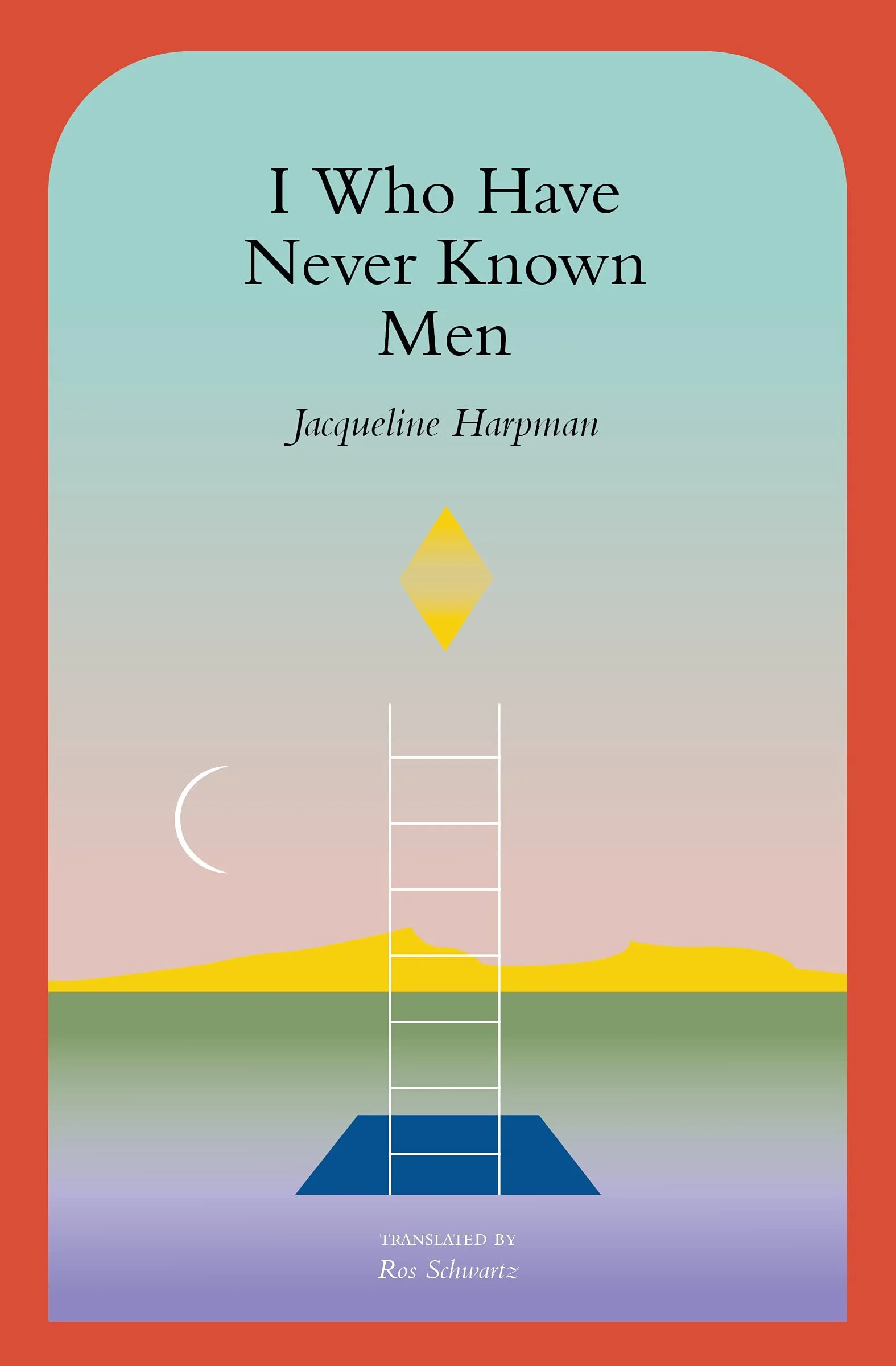
Book Cover via Goodreads